Research
My work sits at the intersection of complex systems science, social dynamics, and organizational theory. I am particularly interested in how heterogeneity shapes emergent outcomes — and what that tells us about equity in social systems.
Behavioral and Topological Heterogeneities in Network Versions of Schelling's Segregation Model
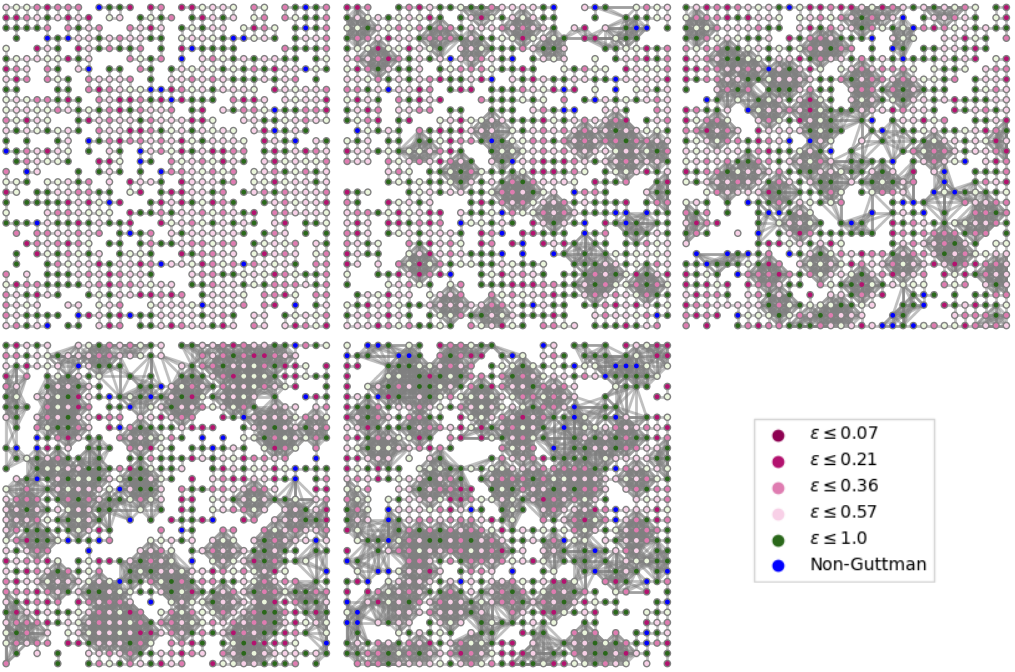
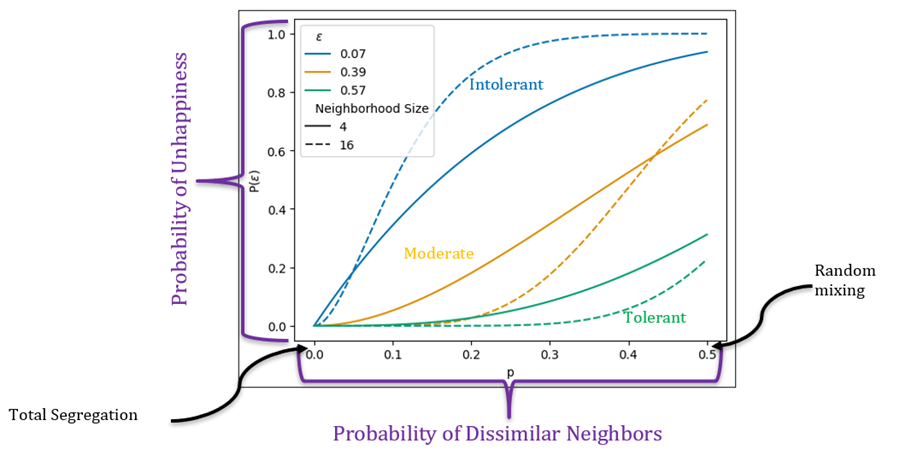
Agent-based models of residential segregation have been of persistent interest to various research communities since their origin with James Sakoda and popularization by Thomas Schelling. Previous investigation incorporating heterogeneity of behaviors (preferences) showed reductions in segregation, while previous investigation incorporating heterogeneity of social network topologies showed no significant impact. In the present study, we examined the effects of the concurrent presence of both behavioral and topological heterogeneities in network segregation models. Simulations were conducted using homogeneous and heterogeneous preference models on 2D lattices with varied levels of densification to create topological heterogeneities. Results show a richer variety of outcomes, including novel differences in segregation levels and hub composition. Notably, with concurrent increased representations of both heterogeneous types, reduced segregation emerges. Simultaneously, a novel dynamic appears where highly tolerant nodes take residence in dense areas and push intolerant nodes to sparse areas — mimicking the urban–rural divide.
A Measure of Interactive Complexity in Network Models
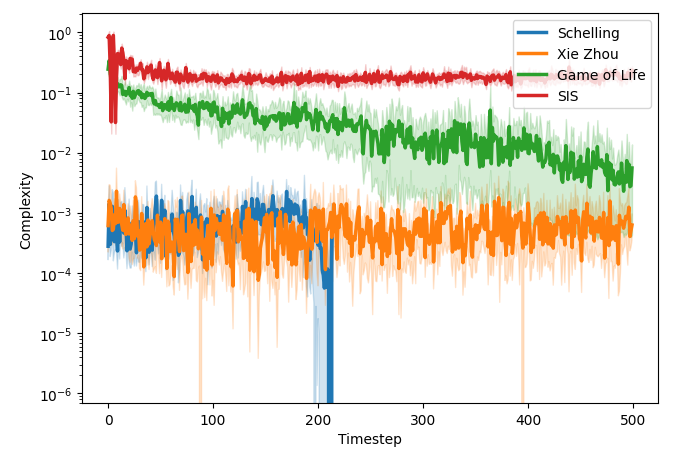
This work presents an innovative approach to understanding and measuring complexity in network models. We revisit several classic characterizations of complexity and propose a novel measure that represents complexity as an interactive process. This measure incorporates transfer entropy and Jensen-Shannon divergence to quantify both the information transfer within a system and the dynamism of its constituents' state changes. To validate the measure, we apply it to several well-known simulation models implemented in Python, including two models of residential segregation, Conway's Game of Life, and the Susceptible-Infected-Susceptible (SIS) model. Results reveal varied trajectories of complexity, demonstrating the efficacy and sensitivity of the measure in capturing the nuanced interplay of interactivity and dynamism in different systems. The results corroborate the notion that heterogeneity and stochasticity increase system complexity.
Social Swarm Optimization: Culturally Mediated Search on NK Landscapes
How do groups of agents find good solutions when the problem space is rugged and interdependent? This dissertation introduces Social Swarm Optimization (SSO), a computational model in which agents search a fitness landscape not by following a global leader, but by forming and dissolving social connections based on cultural tolerance — how similar an agent is willing to be to its neighbors. Those connections evolve as interactions succeed or fail, producing a network structure that co-adapts with the search itself.
Using genetic algorithms to evolve high-performing configurations across landscapes of varying complexity, the research asks: what does it take to search effectively when the terrain gets harder? The answer, it turns out, is less about any single parameter and more about heterogeneity — swarms that maintain a diversity of tolerance levels consistently outperform those that converge on a shared norm, especially on rugged landscapes where premature consensus is fatal.
Articles
The Narrowing
The third in a series on AI and leadership. Where earlier articles examined cognitive debt and cognitive surrender in individuals, this piece asks what happens when AI doesn't just compromise individual judgment, but degrades the social and organizational feedback mechanisms that individual judgment depends on. Drawing on Assembly Theory, Ashby's Law of Requisite Variety, and the narcissism of small differences, it argues that AI centralizes organizational search — crowding the explored center of the possibility space while the edges go dark — and that the corrective (diverse social feedback) erodes alongside the problem.
Staying at the Wheel
The second in the series. Builds on Kahneman's dual-process model and Shaw & Nave's research on cognitive surrender — the point at which users stop evaluating AI output and begin accepting it as their own judgment. Argues that emotional intelligence (personal competence and social competence alike) is the cognitive infrastructure that keeps us from surrendering our reasoning to AI, and connects the Johari Window's Blind Spot to the structural role of diverse perspectives in organizational decision-making.
The Work Is the Teacher
The first in the series. Argues that AI adoption risks removing the practice through which leadership capacity is built — and that this isn't new. From Frederick Taylor's stopwatch to management consulting to executive dashboards, each wave of abstraction promised efficiency and quietly eroded a form of craft. Drawing on the ceramics parable from Art and Fear, Ashby's Law of Requisite Variety, MIT cognitive debt research, and a patient safety case study, it asks: what was each delegated task quietly teaching us all along?